 Musei nazionali di Perugia – Direzione regionale Musei nazionali Umbria
 VIPI UPELSI
Vipi Upelsi
La Caccia al Cinghiale Calidonio, mogli e cognate
Alla famiglia (III-II sec. a.C.) appartengono due tombe individuate tra 1843 e 1846 e strettamente legate fra di loro.
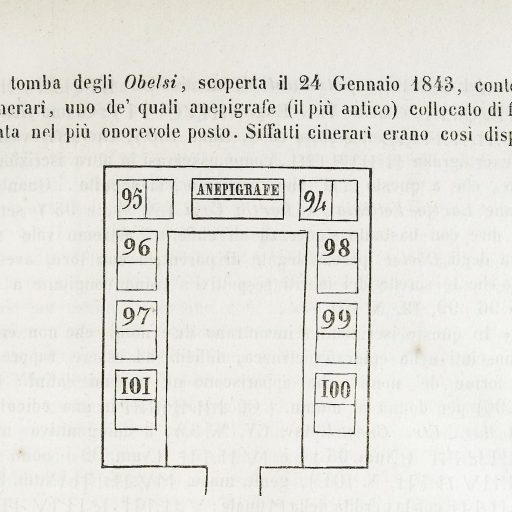
In totale furono rinvenute 14 urne, di cui 5 nella sepoltura indagata nel 1846. Di entrambe le tombe abbiamo le planimetrie con la disposizione delle urne all’interno delle camere funerarie utili alla ricostruzione genealogica. Sulla banchina di fondo della tomba più grande era un sarcofago o un’urna anepigrafe (in genere in questa posizione è il fondatore del sepolcro) con ai lati due donne, sorelle delle mogli (cognate) degli uomini Vipi Upelsi.
Due fratelli, Lar(th) Vipi Upelsi Petrnal e Au[le V]ipi Upelsi Petrnial con le relative mogli e figli hanno scelto invece le banchine di destra e di sinistra della stessa camera.
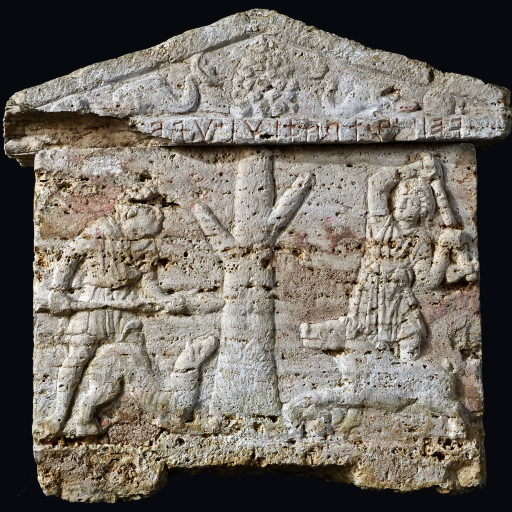
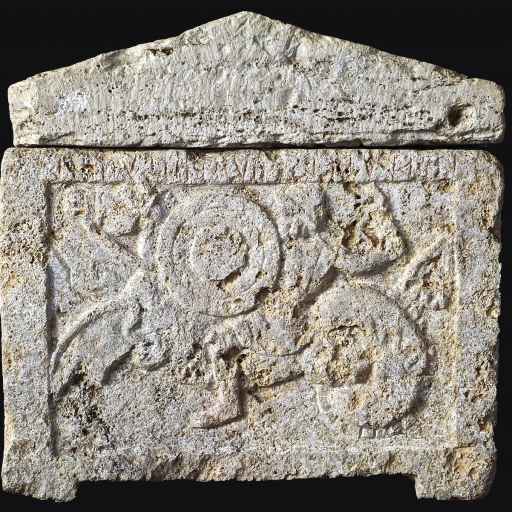
Aule sposò Veilia Trazlui Upelsiś (25) ed insieme riposano sulla banchina di destra. Il figlio, La(rth) Vi(pi) Upelsi Au(leś) Trazlunial (26) è al terzo posto sulla banchina di sinistra. La sorella Larthi Vi(pi) Upelsi Trazlunial (non esposta) è invece deposta nella seconda tomba rinvenuta.
Nonostante le ragioni personali e sociali della scelta della collocazione delle urne non siano completamente comprensibili, si deduce nel complesso un ruolo importante, nell’ambito del contesto familiare, attribuito alle cognate dei Vipi Upelsi, deposte ai lati del posto d’onore occupato dall’urna non iscritta della parete di fondo, un ruolo in altri casi riservato ad altri componenti femminili della famiglia quali suocere o madri, rimaste vedove, dei fondatori della tomba.
L’urna di Veilia Trazlui Upelsiś (25) è decorata sul coperchio da due delfini ai lati di una pigna.
La scena scolpita sulla cassa ruota attorno a un albero spoglio, che funge da asse compositivo dell’intera rappresentazione. Ai lati del tronco sono due figure maschili con corta veste. Il personaggio a destra è raffigurato nell’atto di impugnare un’ascia, un gesto che sembrerebbe alludere all’abbattimento dell’albero; quello a sinistra ha una lancia e sembra rivolto verso la parte inferiore destra della scena dove è un cinghiale, a sinistra è raffigurato un cane. La composizione, anche se in uno schema inusuale, è riconducibile al mito dell’uccisione del cinghiale calidonio, inviato da Artemide, irata per un mancato sacrificio, a devastare la regione greca d’Etolia. Il re di Calidone, Oineo, per fermare la terribile calamità, organizzò una grande battuta di caccia a cui presero parte eroi e semidei, Giasone, Teseo, Castore e Polluce, Peleo, l’amazzone Atalanta e Meleagro, figlio del re (lo stesso tema anche sull’urna 46 dei Tite Petruni).
Il soggetto si inserisce nel più ampio repertorio delle scene di caccia eroica e lotta contro fiere e creature mostruose, frequentemente scolpite sulle urne ellenistiche per il forte valore simbolico e la capacità di alludere, in ambito funerario, al confronto con la morte, al coraggio e alla prova estrema.
Sull’urna di Veilia il tema non sembra essere concepito come narrazione completa ma piuttosto come evocazione selettiva dell’episodio venatorio, condensato in pochi elementi riconoscibili: la presenza del cinghiale, dei cacciatori armati e del paesaggio ridotto a tronco scheletrico al centro della scena, quasi metafora della morte stessa.
Immagini:
- Planimetria della tomba 1 dei Vipi Upelsi tratta daC. Conestabile, G.B. Vermiglioli, Dei Monumenti di Perugia etrusca e romana, Perugia, 1855-1870.
- Urna 25.
- Urna 26.
Vipi Upelsi
The Calydonian Boar Hunt, Wives and Sisters-in-law
Two closely related tombs, dating from the third-second centuries BC and belonging to the same family, were discovered between 1843 and 1846.
Together they contained fourteen urns, five of which were found in the tomb excavated in 1846. Ground plans recording the position of the urns within both burial chambers survive and have proved invaluable in reconstructing the family’s genealogy. On the rear bench of the larger tomb stood either a sarcophagus or an uninscribed urn. Since this position was normally reserved for the founder of the tomb, it is likely that the burial belonged to the family’s founder. On either side were buried two women, the sisters of the wives (sisters-in-law) of the Vipi Upelsi brothers.
The two brothers, Lar(th) Vipi Upelsi Petrnal and Au[le V]ipi Upelsi Petrnial, together with their wives and children, instead occupied the right- and left-hand benches of the same burial chamber.
Aule married Veilia Trazlui Upelsiś (25), and the couple were buried together on the right-hand bench. Their son, La(rth) Vi(pi) Upelsi Au(leś) Trazlunial (26), occupied the third position on the left-hand bench, while his sister, Larthi Vi(pi) Upelsi Trazlunial (not on display), was buried in the second tomb.
Although the personal and social reasons behind the arrangement of the urns cannot be fully understood, the overall layout suggests that the sisters-in-law of the Vipi Upelsi family occupied a position of particular importance. They were buried on either side of the place of honour occupied by the uninscribed urn against the rear wall, a position that in other family tombs was sometimes reserved for other female relatives, such as the widowed mothers or mothers-in-law of the tomb’s founders.
The lid of Veilia Trazlui Upelsiś‘s urn (25) is decorated with two dolphins flanking a pine cone.
The relief carved on the front of the urn is organised around a leafless tree, which forms the compositional axis of the scene. On either side stand two short-tunicked male figures. The figure on the right raises an axe, apparently preparing to fell the tree, while the figure on the left carries a spear and faces the lower right-hand corner of the composition, where a wild boar is depicted; a hunting dog appears on the left.
Although presented in an unusual composition, the scene can be identified as the myth of the Calydonian Boar Hunt. According to Greek mythology, Artemis, angered by the omission of a sacrifice in her honour, sent a monstrous boar to ravage the region of Aetolia. To end the devastation, King Oeneus of Calydon organised a great hunt in which heroes and demigods – including Jason, Theseus, Castor and Pollux, Peleus, the Amazon Atalanta and Meleager, son of the king Oeneus – took part. The same subject also appears on urn 46 belonging to the Tite Petruni family.
This episode belongs to the broader repertoire of heroic hunting scenes and combats with wild beasts or monstrous creatures that frequently decorate Hellenistic urns. Such imagery carried powerful symbolic meaning and, in a funerary context, evoked courage, the ultimate trial, and the confrontation with death.
On Veilia‘s urn, however, the myth is not presented as a complete narrative but rather as a selective evocation of the hunt, condensed into a few recognisable elements: the wild boar, the armed hunters, and the barren tree at the centre of the composition, reduced almost to a metaphor for death itself.
Images:
- Plan of tomb 1 of the Vipi Upelsi family, fromC. Conestabile, G.B. Vermiglioli, Dei Monumenti di Perugia etrusca e romana, Perugia, 1855-1870.
- Urn 25.
- Urn 26.
Galleria fotografica (scorri)
25 September 2026
1 planimetria della tomba
25 September 2026
2 urna 25
25 September 2026
3 urna 26
Ultimo aggiornamento
29 Settembre 2026, 16:00