 Musei nazionali di Perugia – Direzione regionale Musei nazionali Umbria
 URNA ANONIMA (ANEPIGRAFE)/AN ANONYMOUS URN (ANEPIGRAPHIC)
Urna anonima (anepigrafe)
Un coperchio raffinato e la cosiddetta follia di Atamante
Si definisce anepigrafe un’urna priva di epitaffio inciso o dipinto, come nel caso del n. 60. La mancanza dell’iscrizione (difficile immaginare che fosse solo dipinta e andata perduta) non ha permesso di associare l’urna a nessuna delle famiglie del Palazzone ad oggi note.
Si propone comunque all’attenzione del pubblico soprattutto per il raffinato livello qualitativo del coperchio configurato, che può essere accostato, per accuratezza e plasticità del modellato, a quelli di Arnth Cai Cutu o dei Velimna (seconda metà del III sec. a.C.).
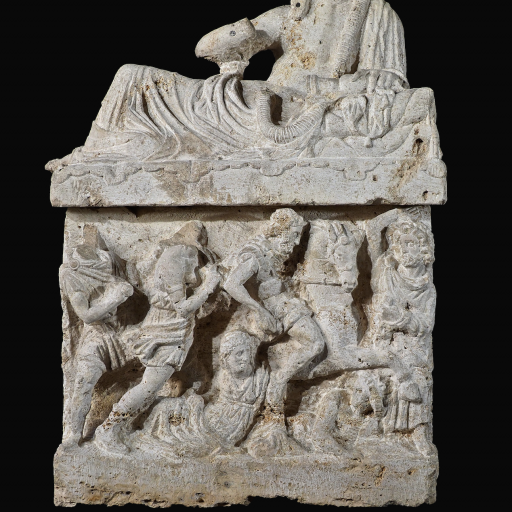
Il defunto, oggi privo della testa, è mollemente adagiato a banchetto, secondo un’usanza diffusa dal VI sec. a.C. e di origine orientale, che prevedeva di pasteggiare semisdraiati anziché seduti.
Il banchetto raffigurato è probabilmente quello dell’Oltretomba, celebrato per l’eternità nei Campi Elisi insieme ai propri familiari.
Nella mano sinistra appoggiata ai cuscini, tiene un’anforetta/craterisco, recipiente legato al vino e a Dioniso, meno usuale della patera (piatto fondo), in genere attributo dei commensali maschili.
Il torace è nudo, un mantello copre la parte inferiore del corpo e risale sulla spalla sinistra, con piccole nappe alle estremità. Il braccio destro è piegato al gomito e sorretto da un puntello all’altezza dei fianchi. La mano non è conservata. Al collo, come frequente per gli uomini, una ghirlanda costituita da dischi sottili strettamente affiancati.
Pregevole la resa plastica del torace e del mantello e soprattutto della mano sinistra finemente modellata. Interessante l’uso di perni in piombo presso il collo, la ghirlanda e il braccio destro, forse per assemblare parti lavorate separatamente o per intervenire con un antico restauro.
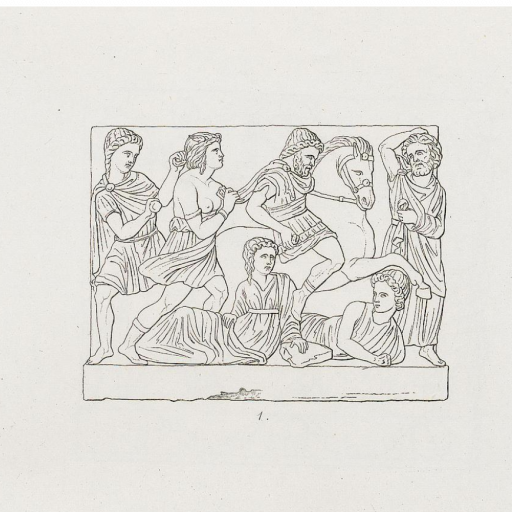
Di buon livello anche il rilievo, piuttosto aggettante, della cassa che mostra al centro un cavaliere in corsa verso destra che travolge un personaggio sotto le zampe. A sinistra due figure (un guerriero e una Vanth, demone femminile con stivaletti, corta veste e torace scoperto, che affianca i personaggi della scena a sottolineare l’ineluttabilità del destino), a destra un personaggio barbato che solleva un braccio in gesto di disperazione. Sotto il cavallo un’ulteriore figura femminile semisdraiata. La cassa è eccezionalmente decorata anche sui lati con rosette a quattro petali entro riquadro ribassato.
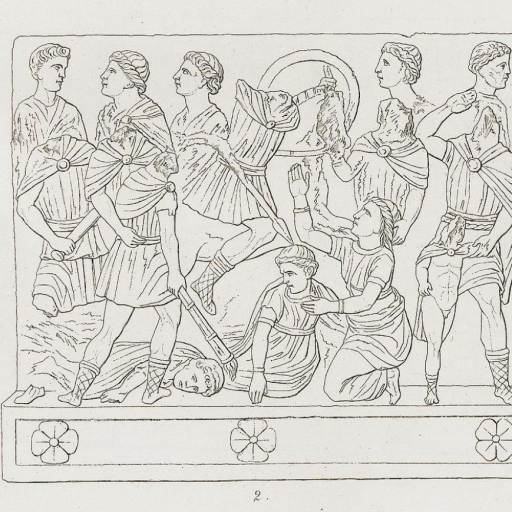
La scena, non riconducibile semplicemente ad una battaglia, per la presenza della figura semisdraiata, potrebbe raffigurare la cosiddetta follia di Atamante, mito greco di cui abbiamo molte varianti e un lungo racconto nelle Metamorfosi di Ovidio (libri III-IV). Atamante re di Orcomeno sposa in seconde nozze Ino, da cui ha due figli, Learco e Melicerte. La coppia è colpevole, agli occhi di Giunone, per aver allevato il piccolo Dioniso, figlio di Giove, sopravvissuto alla morte della madre Semele e cresciuto dalla sorella di quest’ultima, Ino. Giunone fa impazzire Atamante che stermina i propri figli e sbatte, credendolo selvaggina, Learco contro una roccia. Ino, per strappare Melicerte ad Atamante, lo porta con sé gettandosi in mare. Rispetto all’urna 58 dei Tite Petruni la figura sulla destra non sorregge (e protegge) un infante e dunque difficilmente è interpretabile, come proposto per altri casi, come pedagogo. La figura femminile a terra potrebbe essere la stessa Ino.
Se l’interpretazione del mito, piuttosto incerta, coglie nel segno, tra i significati possibili, un avvertimento e un monito a non oltraggiare gli dei e un’allusione a drammi familiari potrebbero spiegare l’origine e la diffusione dell’iconografia sulle urne etrusche perugine a partire dalla fine del III sec. a.C.
Immagini:
- Urna 60.
- La cd. follia di Atamante (urna 60), tavola tratta da H. Brunn, G. Koerte, I rilievi delle urne etrusche, Roma 1870.
- La cd. follia di Atamante (urna 58, Tite Petruni), tavola tratta da H. Brunn, G. Koerte, I rilievi delle urne etrusche, Roma 1870.
An anonymous Urn (anepigraphic)
An Exquisitely carved Lid and the so-called Madness of Athamas
An urn without an inscription, whether incised or painted, is described as anepigraphic, as in the case of no. 60. The absence of an inscription—it is difficult to imagine that it was merely painted and subsequently lost—has made it impossible to associate the urn with any of the Palazzone families known to date.
It is nevertheless presented to the public above all for the refined quality of its sculpted lid, which can be compared, in the precision and plasticity of its modelling, with those of Arnth Cai Cutu and the Velimna (second half of the third century BC).
The deceased, now headless, reclines languidly at a banquet, following a custom introduced from the sixth century BC and of eastern origin, according to which meals were eaten semi-reclining rather than seated.
The banquet depicted is probably that of the Afterlife, celebrated for eternity in the Elysian Fields together with one’s family.
In his left hand, resting on the cushions, he holds a small amphora or crateriskos, a vessel associated with wine and Dionysus and less commonly represented than the patera (a shallow dish), which was generally an attribute of male banqueters.
His torso is bare, while a cloak covers the lower part of his body and rises over his left shoulder, with small tassels at the ends. His right arm is bent at the elbow and supported by a prop at hip level. The hand is missing. Around his neck, as is frequently found in representations of men, is a wreath made of thin, closely set discs.
The modelling of the torso and cloak is particularly fine, as is that of the delicately rendered left hand. Of interest is the use of lead pins around the neck, wreath and right arm, perhaps to assemble separately worked parts or to carry out an ancient restoration.
The relief on the chest is also of a high standard. It is rather prominently modelled and depicts, at the centre, a horseman galloping towards the right and trampling a figure beneath the horse’s hooves. On the left are two figures, a warrior and a Vanth, a female demon wearing ankle boots and a short garment, with her torso exposed; she stands alongside the figures in the scene, emphasising the inevitability of fate. On the right, a bearded figure raises one arm in a gesture of despair. Beneath the horse is another female figure, shown semi-reclining. The chest is exceptionally decorated on its sides as well, with four-petalled rosettes set within recessed panels.
The scene cannot be interpreted simply as a battle because of the presence of the semi-reclining figure. It may instead represent the so-called Madness of Athamas, a Greek myth known in numerous versions and recounted in detail in Ovid’s Metamorphoses (Books III–IV). Athamas, king of Orchomenus, marries Ino as his second wife, and they have two sons, Learchus and Melicertes. In Juno’s eyes, the couple are guilty of having raised the infant Dionysus, son of Jupiter, who survived the death of his mother Semele and was brought up by her sister Ino. Juno drives Athamas mad, causing him to slaughter his own children and, mistaking Learchus for wild game, hurl him against a rock. To save Melicertes from Athamas, Ino takes him with her and throws herself into the sea. In comparison with urn 58 of the Tite Petruni, the figure on the right is not holding or protecting an infant and can therefore hardly be interpreted, as has been proposed in other cases, as a pedagogue. The female figure lying on the ground may be Ino herself.
If this rather uncertain interpretation of the myth is correct, among its possible meanings, a warning against offending the gods and an allusion to family tragedies could explain the origin and spread of this iconography on Etruscan urns from Perugia from the end of the third century BC onwards.
Images:
- Urn 60.
- The so-called ‘Madness of Athamas’ (urn 60), drawing from H. Brunn, G. Koerte, I rilievi delle urne etrusche, Roma 1870.
- The so-called ‘Madness of Athamas’ (urn 58, Tite Petruni), drawing from H. Brunn, H. Brunn, G. Koerte, I rilievi delle urne etrusche, Roma 1870.
Galleria fotografica (scorri)
25 September 2026
1 urna 60
25 September 2026
2 tavola urna 60
25 September 2026
3 urna 58
Ultimo aggiornamento
29 Settembre 2026, 15:54