 Musei nazionali di Perugia – Direzione regionale Musei nazionali Umbria
 AFLE
Afle
Una porta girevole, un pozzo e una fascia pectoralis
Alla tomba (II-I sec. a.C.), scoperta nel 1844, si accedeva attraverso un corridoio che conduceva ad una grande porta in travertino, munita di cardini girevoli e fornita di maniglia metallica.
All’interno fu rinvenuto un pozzo circolare scavato al centro della camera (profondo m. 1,50 e largo cm 87) coperto da una pietra, che ricorda quanto documentato per la tomba A visitabile lungo il percorso di visita. Il rinvenimento di resti di carbone ha fatto ipotizzare un ustrinum, un luogo destinato da Etruschi e Romani alla cremazione dei defunti.
Gli Afle erano verosimilmente imparentati con i Veti Afle come documenta l’urna di Arnth Afle Veti figlio di una Vipi, rinvenuta in questa tomba.
Se(thre) Afle La(rthial) e Fa(sti) Hustnei Arznal atiu, sepolti insieme, potrebbe essere stati i fondatori del sepolcro (la loro urna potrebbe contenere tre individui se si accetta l’interpretazione di atiu come bambino, infante). La coppia ebbe un figlio, La(rth) Afle Se(threś) Hustnal, e una figlia, Afli Hustnal śeχ farthana (62, śeχ farthana è appellettivo composto da śeχ, “figlia” e un termine incerto, nel significato forse di “figlia adottiva/figliastra”). Il padre di Sethre potrebbe essere La(rth) Afle Se(threś) An(e)inal. Lo stesso metronimico, ma un diverso patronimico, compare nel nome di Laris Aufle Larisal Aneinal. Può darsi che Sethre (o Laris) avesse sposato la vedova del fratello. T(ar)ch(is) Afles Ulthial (61) e Laris Afle Ulthial (37) erano fratelli, ma, senza il patronimico, non è possibile determinare la loro collocazione nell’albero genealogico, così come nel caso di Ar(nth) Afle Veti Vipial (50) o Se(thre) Afle La(rthial) Facual.
La tomba conteneva urne cinerarie di pregio.
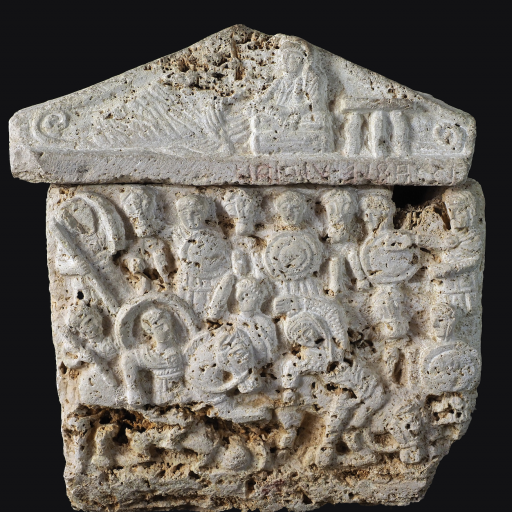
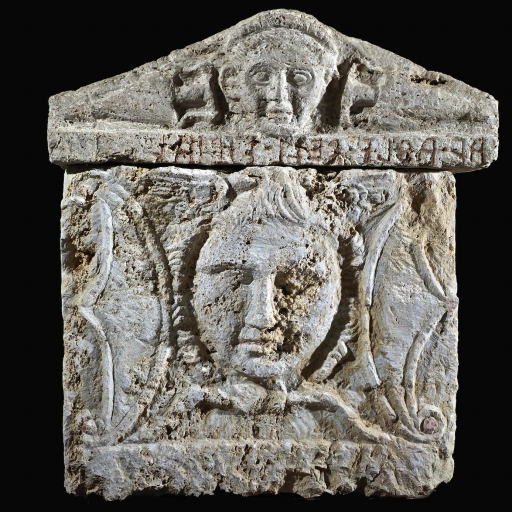
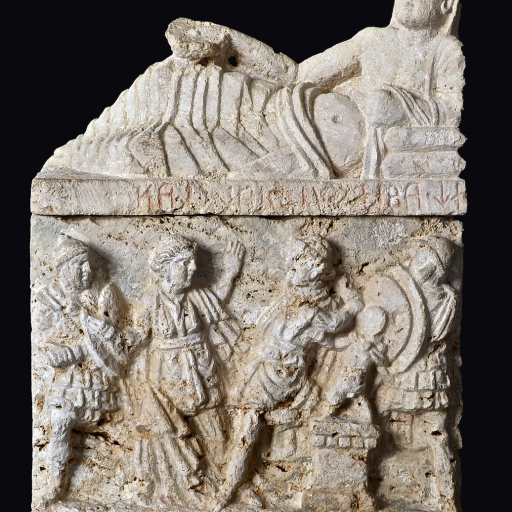
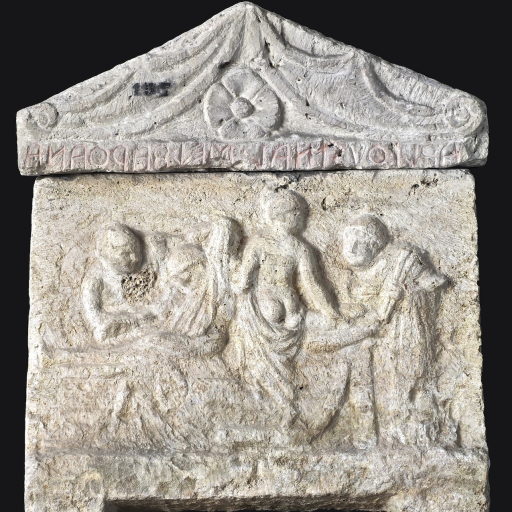
Delle 9 urne (solo due pertinenti a donne), 6 hanno sculture sul coperchio, una presenta un banchetto (37), una il motivo ricorrente del fiore tra due pelte (62), un’altra un volto maschile tra due anfore sul coperchio e una gorgone tra pelte sulla cassa (50). La maggior parte delle casse conservate presentano rilievi mitologici, tra cui il sacrificio di Ifigenia (urne a Villa Giulia e presso privati); Telefo e il piccolo Oreste (61), scene di battaglia (37) e una scena di intimità femminile di difficile interpretazione (62).
Rimandiamo alla famiglia Cai Carcu, esposta nell’Antiquarium, per il mito di Oreste e Telefo (61), per la scena di battaglia alla famiglia Cafate (39) e per il sacrificio di Ifigenia ai Tite Petruni (69).
Ci soffermiamo sulle raffigurazioni dell’urna 62.
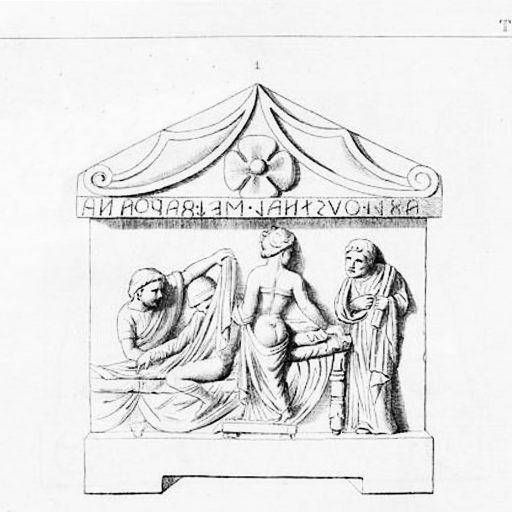
Sulla cassa sono quattro personaggi. Un giovane semisdraiato su una kline (letto) è parzialmente coperto da un drappo che un personaggio femminile sembra sollevare. Sulla destra compare un personaggio ammantato, accanto al quale si distingue una figura femminile di schiena, resa con una particolare evidenza plastica che enfatizza l’armonia del corpo e il movimento: la fanciulla, con capelli raccolti sulla sommità del capo, è vestita della sola fascia pectoralis; le gambe sono avvolte in un morbido panneggio.
Sappiamo dalle fonti latine che la fascia pectoralis non era solo un indumento femminile ma rispondeva anche ad esigenze di decoro, eleganza e stile, ed era usata nella danza, nell’attività fisica, ai bagni termali, spesso abbinata al subligar o subligaculum, una sorta di sgambato e succinto perizoma così da comporre un vero e proprio “bikini” ante litteram.
La scena è stata oggetto di differenti interpretazioni e ricondotta all’episodio raccontato nella perduta tragedia delle Cretesi di Euripide (V sec. a.C.), in particolare alla vicenda di Catreo, figlio di Minosse, che sorprende la figlia Erope con un servo in una relazione illecita, alla presenza di figure impegnate a occultare le tracce del misfatto. È stata anche ipotizzata un’allusione ad Afrodite/Venere o una scena intima di vita quotidiana, priva di esplicito riferimento mitologico.
IMMAGINI:
- Urna 37.
- Urna 50.
- Urna 61.
- Urna 62.
- Urna 62, disegno tratto da G.C. Conestabile, G.B. Vermiglioli, Dei Monumenti di Perugia etrusca e romana, Perugia, 1855-1870.
Afle
A Pivot Door, a Well and a Fascia Pectoralis
This tomb, dating from the second to the first century BC, was discovered in 1844. It was accessed by a corridor leading to a large travertine doorway fitted with pivoting hinges and a metal handle.
Inside, archaeologists uncovered a circular shaft cut into the centre of the burial chamber (1.50 m deep and 87 cm in diameter), sealed with a stone slab. This feature recalls that documented in Tomb A, which can be visited along the visitors route in the necropolis. The discovery of charcoal remains has led to the suggestion that it functioned as an ustrinum, the place where Etruscans and Romans cremated their dead.
The Afle family was probably related to the Veti Afle branch, as indicated by the urn of Arnth Afle Veti, son of a woman named Vipi, discovered in this tomb.
Se(thre) Afle La(rthial) and Fa(sti) Hustnei Arznal atiu, buried together, may have been the founders of the tomb. Their urn may even have contained the remains of three individuals, if atiu is correctly interpreted as meaning ‘child’ or ‘infant’. The couple had a son, La(rth) Afle Se(threś) Hustnal, and a daughter, Afli Hustnal śeχ farthana (62). This compound epithet combines śeχ (‘daughter’) with a second term of uncertain meaning, perhaps indicating an adopted daughter or stepdaughter. Sethre‘s father may have been La(rth) Afle Se(threś) An(e)inal. The same metronymic, but with a different patronymic, appears in the name Laris Afle Larisal Aneinal, raising the possibility that Sethre—or perhaps Laris—married his brother’s widow. T(ar)ch(is) Afles Ulthial (61) and Laris Afle Ulthial (37) were brothers, but without their patronymics it is impossible to determine their precise place within the family tree. The same applies to Ar(nth) Afle Veti Vipial (50) and Se(thre) Afle La(rthial) Facual.
The tomb contained a number of finely crafted cinerary urns. Of the nine urns recovered—only two belonging to women—six are surmounted by sculpted lids. One depicts a funerary banquet (37), another bears the common motif of a flower between two peltae (62), while another features a male face between two amphorae on the lid and a Gorgon’s head flanked by peltae on the front of the chest (50). Most of the preserved chests are decorated with mythological reliefs, including the Sacrifice of Iphigenia (represented on urns now in the Museo Nazionale Etrusco di Villa Giulia and in private collections), Telephus and the baby Orestes (61), battle scenes (37), and a female intimate scene whose interpretation remains uncertain (62).
For the myth of Orestes and Telephus (61), see the Cai Carcu family displayed in the Antiquarium; for the battle scene, see the Cafate family (39); and for the Sacrifice of Iphigenia, see the Tite Petruni family (69). Here we shall focus on the imagery decorating urn 62.
The front of the chest is carved with four figures. A young man reclines on a kline (couch), partially covered by a drapery that a female figure appears to be lifting. To the right stands a cloaked figure, beside whom is a female figure shown from behind, rendered with remarkable plasticity that emphasises both the harmony of her body and the fluidity of her movement. Her hair is gathered on the crown of her head; she wears only a fascia pectoralis, while her legs are wrapped in soft drapery.
Latin literary sources tell us that the fascia pectoralis was not merely a woman’s undergarment. It also fulfilled ideals of modesty, elegance and style, and was worn while dancing, exercising and bathing. It was often paired with a subligar or subligaculum, a brief loincloth, together forming what might be described as an ancient precursor of the modern bikini.
The scene has been interpreted in several different ways. One proposal links it to an episode from Euripides’ lost tragedy The Cretans (fifth century BC), in which Catreus, son of Minos, discovers his daughter Aerope engaged in an illicit relationship with a servant while other figures attempt to conceal the evidence of the affair. Other scholars have suggested that it alludes to Aphrodite (Venus), or that it simply depicts an intimate scene from everyday life, without any explicit mythological reference.
IMAGES:
- Urn 37.
- Urn 50.
- Urn 61.
- Urn 62.
- Urn 62, drawing fromC. Conestabile, G.B. Vermiglioli, Dei Monumenti di Perugia etrusca e romana, Perugia, 1855-1870.
Galleria fotografica (scorri)
24 September 2026
1 urna n 37
24 September 2026
2 urna n 50
24 September 2026
3 urna 61
24 September 2026
4 urna 62
24 September 2026
5 urna 62 disegno conestabile
Ultimo aggiornamento
29 Settembre 2026, 15:50