 Musei nazionali di Perugia – Direzione regionale Musei nazionali Umbria
 TITE PETRUNI
Tite Petruni
Amore coniugale e miti per una famiglia aristocratica perugina
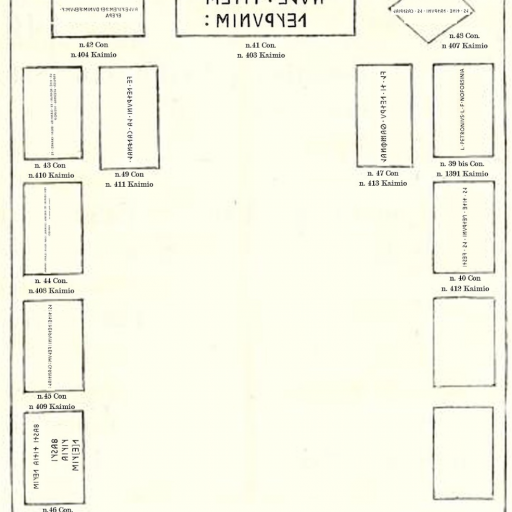
Scoperta nel 1843 nella necropoli del Palazzone, la tomba a camera, di cui possediamo la planimetria, ospitava 13 urne oggi in parte disperse. Tra gli oggetti di corredo uno specchio in bronzo e due strigili.
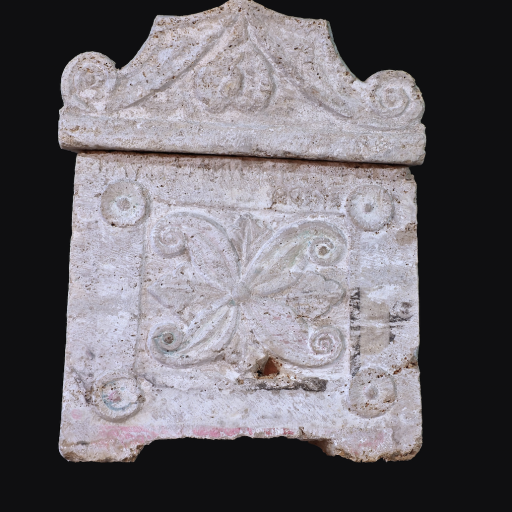
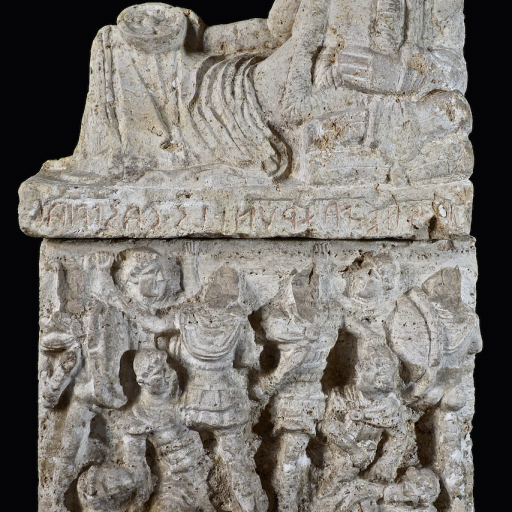
Le deposizioni più antiche occupavano la parete di fondo: al centro l’urna perduta di Aule Titeś Petruniś, affiancata da Aule Titeś Petruniś Veluś (T)iteś etera (34, l’appellativo etera è di incerto significato) e L(ari)s Tite Petruni L(ari)s(al) Casprial (68). L’urna 34 è decorata con pelte, foglie e patere; la 68 raffigura il defunto semireclinato su kline (letto) e una vivace scena di battaglia.
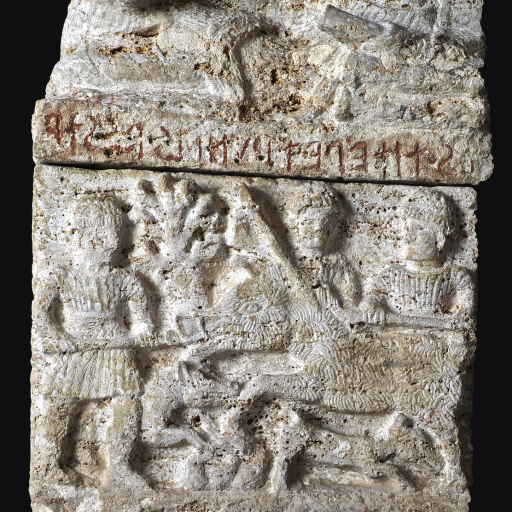
Presso la parete destra era collocata l’urna di L(ari)s Tite Petruni L(ari)s(al) Vesta(rcnal?) (46), probabilmente figlio del n. 68. Il coperchio lo mostra con rotolo e craterisco, simboli di rango, mentre la cassa raffigura la caccia al cinghiale Calidonio, episodio che celebra il coraggio e l’eroizzazione del defunto (sul tema anche l’urna 25, Vipi Upelsi). L’urna anepigrafe 17 nell’allestimento 2026 è stata attribuita alla famiglia Tite Petruni grazie alla accurata rilettura della descrizione ottocentesca dei cinerari dell’ipogeo.
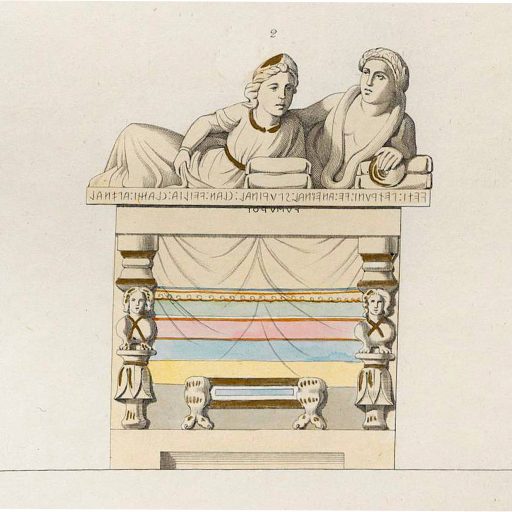
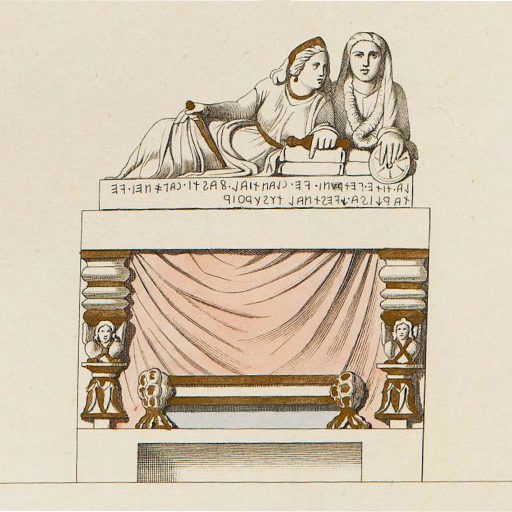
Al centro della parete sinistra si trovava l’urna dei coniugi Ve(l) Ti(te) Petruni Ve(luś) Aneinal Spurinal clan e Veilia Clanti Arznal. Alla loro destra era l’urna del figlio La(rth) Tite Petruni Ve(luś) Clantial e della moglie di lui Fasti Capznei Ve(luś) Tarchisa Chvestnal. Entrambe le coppie, esposte all’Antiquarium, sono definite nell’iscirizione tuśurthi/“coniugi”. Il termine, secondo una possibile interpretazione, deriverebbe dal numerale thu/uno a cui si aggiunge il locativo nel senso di “in uno”, “nello stesso luogo, forma, modo” con una costruzione non diversa dal latino “simul” o dall’italiano “insieme”. Se si accetta questa interpretazione il termine enfatizza l’unione e l’amore coniugale sottolineando che gli sposi sono e saranno per sempre “insieme” in un’unica fusione di anime.
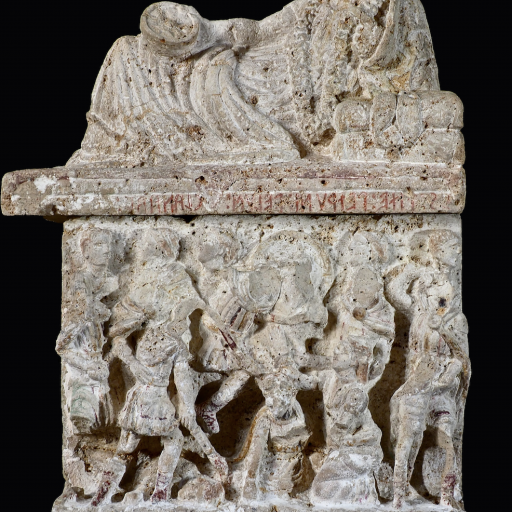
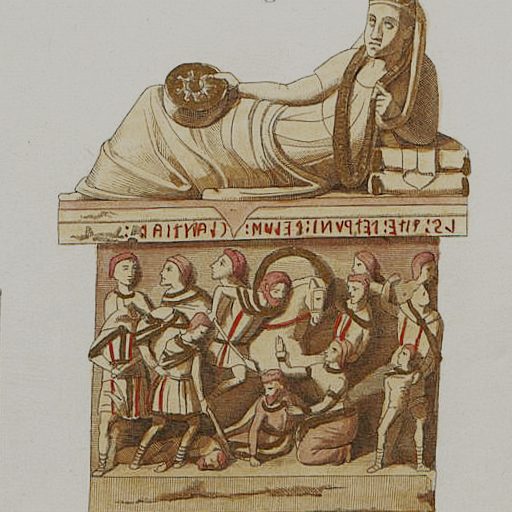
Alla sinistra si trova il fratello di Larth, L(ari)s Tite Petruni Veluś Clantial (58), con la cassa decorata con scena di combattimento, probabilmente riferibile alla follia di Atamante (sul tema anche l’urna anepigrafe 60). Proprio davanti all’urna bisoma dei genitori era deposta quella del figlio Ve(l) Ti(te) Petruni Larthial Capznal (69).
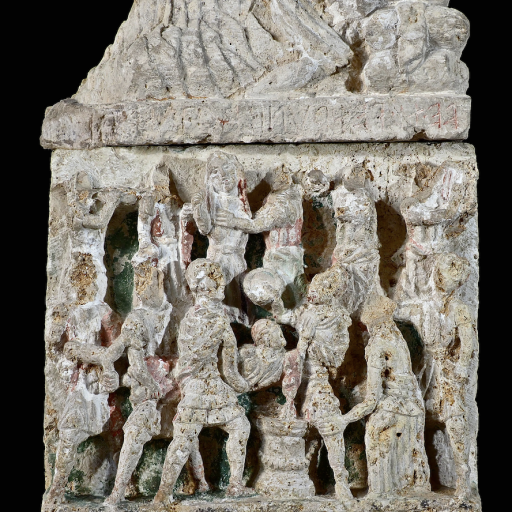
Sul coperchio il defunto partecipa di un eterno banchetto, semireclinato su una kline (letto), con patera e collana. La cassa illustra il Sacrificio di Ifigenia, tra i miti più documentati nell’arte funeraria etrusca, organizzato su due registri. In alto offerenti e musici con lira e flauto; in basso Ifigenia, sorretta da Ulisse, è condotta all’altare davanti ad Agamennone che solleva una patera (piatto fondo). Artemide, che sorregge un cerbiatto, interviene per salvare la giovane sostituendo la vittima sacrificale con l’animale, mentre la madre Clitemnestra è prostrata dal dolore. Rosette, bucrani e ghirlande incorniciano il rilievo, enfatizzandone il significato rituale, funerario e salvifico.
Di rilievo anche l’urna di V(e)l Ti(te) Petru(ni) Hamphnal (74).
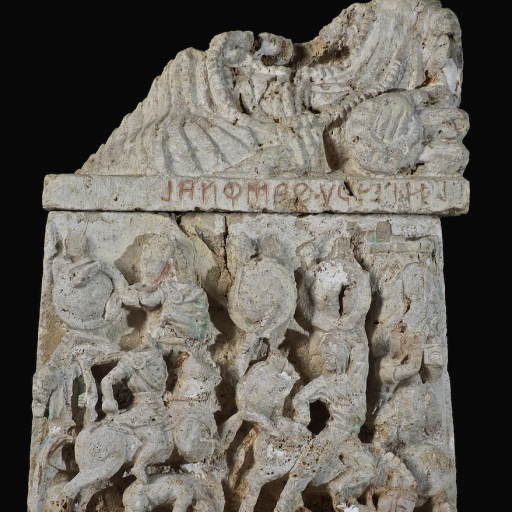
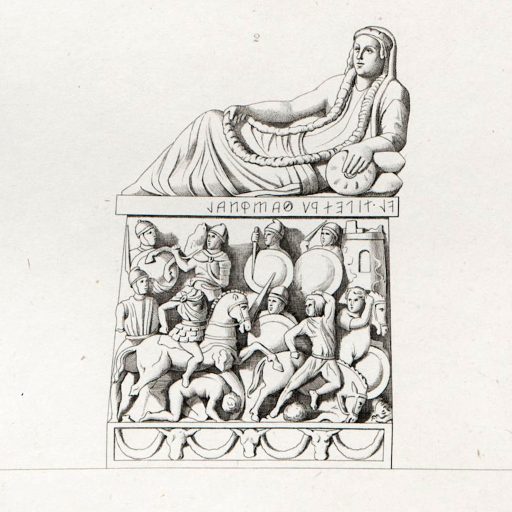
Nel precedente allestimento il coperchio e la cassa non risultavano associati tra loro; l’attuale ricomposizione è frutto di ricerche storiche e documentarie che attestano anche che il defunto ero un uomo e a capo velato. A seguito di un erroneo restauro è stata invece applicata una testa femminile non pertinente. Sulla cassa un affollato combattimento tra Greci e Persiani con Alessandro Magno che impugna una lunghissima lancia non presente nel rilievo e forse in origine inserita in bronzo (sul tema anche le urne 37, Afle e 39, Cafate).
Presso la parete destra era anche l’urna latina di L(ucius) Petronius L(uci) f(ilius) Noforsinia (gnatus) (47), probabilmente l’ultima deposizione della tomba che documenta almeno tre/quattro generazioni della famiglia (II- I sec. a.C.) imparentata con le gentes Caspre, Anei Spurina, Arzni, Clante, Chvestna, Capzna, Vestarcna, Hamphna e Nufrzna.
Immagini:
- Planimetria della tomba rielaborata da G.C. Conestabile, G.B. Vermiglioli, Dei Monumenti di Perugia etrusca e romana, Perugia 1855-1870.
- Urna 34.
- Urna 46.
- Urna 58.
- Urna 58, disegno tratto da G.C. Conestabile, G.B. Vermiglioli, Dei Monumenti di Perugia etrusca e romana, Perugia 1855-1870.
- Urna 68.
- Urna 69.
- Urna 74.
- Urna 74, disegno tratto da G.C. Conestabile, G.B. Vermiglioli, Dei Monumenti di Perugia etrusca e romana, Perugia 1855-1870.
- Urna bisoma esposta all’Antiquarium, disegno tratto da G.C. Conestabile, G.B. Vermiglioli, Dei Monumenti di Perugia etrusca e romana, Perugia 1855-1870.
- Urna bisoma esposta all’Antiquarium, disegno tratto da G.C. Conestabile, G.B. Vermiglioli, Dei Monumenti di Perugia etrusca e romana, Perugia 1855-1870.
Tite Petruni
Conjugal Love and Myth for an aristocratic Perugian Family
Discovered in 1843 in the Palazzone necropolis, this chamber tomb -of which we have the ground plan- originally contained thirteen urns, some of which are now lost. The grave goods included a bronze mirror and two strigils.
The earliest burials occupied the rear wall of the chamber: at the centre stood the lost urn of Aule Titeś Petruniś, flanked by Aule Titeś Petruniś Veluś (T)iteś etera (34, the meaning of the epithet etera remains uncertain) and L(ari)s Tite Petruni L(ari)s(al) Casprial (68). Urn 34 is decorated with peltae, leaves and paterae; urn 68 depicts the deceased reclining on a kline (couch) and a lively battle scene.
Against the right-hand wall stood the urn of L(ari)s Tite Petruni L(ari)s(al) Vesta(rcnal?) (46), probably the son of individual no. 68. The lid shows him holding a scroll and a small krater, symbols of rank, while the chest depicts the Calydonian Boar Hunt, an episode celebrating the courage and heroic status of the deceased (the same theme appears on urn 25 of the Vipi Upelsi family). The uninscribed urn 17 has been attributed to the Tite Petruni family in the 2026 display thanks to a careful re-examination of nineteenth-century descriptions of the urns from the hypogeum.
At the centre of the left-hand wall was the urn of the married couple Ve(l) Ti(te) Petruni Ve(luś) Aneinal Spurinal clan and Veilia Clanti Arznal. To their right was the urn of their son La(rth) Tite Petruni Ve(luś) Clantial and his wife Fasti Capznei Ve(luś) Tarchisa Chvestnal. Both couples, displayed in the Antiquarium, are described in their inscriptions as tuśurthi, meaning ‘spouses’.
According to one possible interpretation, the term derives from the numeral thu (‘one’) combined with a locative meaning ‘in one’, ‘in the same place, form or manner’, in a construction comparable to the Latin simul or the Italian insieme (‘together’). If this interpretation is accepted, the word emphasises bridal union and affection, expressing the idea that husband and wife are, and will remain, forever ‘together’, united in a single bond.
To the left is the brother of Larth, L(ari)s Tite Petruni Veluś Clantial (58), whose urn chest is decorated with a combat scene, probably referring to the Madness of Athamas (the same subject appears on the uninscribed urn 60). Directly in front of the double urn of his parents was placed the urn of their son Ve(l) Ti(te) Petruni Larthial Capznal (69).
On the lid, the deceased takes part in an eternal banquet, reclining on a kline (couch), holding a patera and wearing a necklace. The chest depicts the Sacrifice of Iphigenia, one of the most frequently represented myths in Etruscan funerary art, arranged in two registers. The upper register shows attendants and musicians playing the lyre and flute; below, Iphigenia, supported by Odysseus, is led towards the altar before Agamemnon, who raises a patera (a shallow ritual bowl). Artemis, holding a fawn, intervenes to save the young woman by replacing the sacrificial victim with the animal, while her mother Clytemnestra collapses in grief. Rosettes, bucrania and garlands frame the relief, emphasising its ritual, funerary and salvific meaning.
Another remarkable urn is that of V(e)l Ti(te) Petru(ni) Hamphnal (74).
In the previous display, the lid and chest were not associated with each other. Their present reconstruction is the result of historical and archival research, which also established that the deceased was a man represented with a veiled head. Following an incorrect restoration, a non-original female head had been attached instead. The chest depicts a crowded battle between Greeks and Persians, with Alexander the Great holding an exceptionally long spear, now missing from the relief and perhaps originally inserted in bronze (the same theme appears on urns 37, Afle, and 39, Cafate).
Against the right-hand wall was also the Latin-inscribed urn of L(ucius) Petronius L(uci) f(ilius) Noforsinia (gnatus) (47), probably the latest deposition in the tomb. It documents at least three or four generations of the family (second-first century BC), which was connected through marriage and kinship with the gentes Caspre, Anei Spurina, Arzni, Clante, Chvestna, Capzna, Vestarcna, Hamphna and Nufrzna.
Images:
- Plan of the tomb, revised from G.C. Conestabile, G.B. Vermiglioli, Dei Monumenti di Perugia etrusca e romana, Perugia 1855-1870.
- Urn 34.
- Urn 46.
- Urn 58.
- Urn 58, drawing from G.C. Conestabile, G.B. Vermiglioli, Dei Monumenti di Perugia etrusca e romana, Perugia 1855-1870.
- Urn 68.
- Urn 69.
- Urn 74.
- Urn 74, drawing from G.C. Conestabile, G.B. Vermiglioli, Dei Monumenti di Perugia etrusca e romana, Perugia 1855-1870.
- Double Urn on display at the Antiquarium, drawing from G.C. Conestabile, G.B. Vermiglioli, Dei Monumenti di Perugia etrusca e romana, Perugia 1855-1870.
- Double Urn on display at the Antiquarium, drawing from G.C. Conestabile, G.B. Vermiglioli, Dei Monumenti di Perugia etrusca e romana, Perugia 1855-1870.
Galleria fotografica (scorri)
25 September 2026
1 Planimetria della tomba rielaborata da Conestabile
25 September 2026
2 urna 34
25 September 2026
3 urna 46
25 September 2026
4 urna 58
25 September 2026
5 urna 58
25 September 2026
6 urna 68
25 September 2026
7 urna 69
25 September 2026
8 urna 74
25 September 2026
9 urna 74 Monumenti venuti alla luce per escavazioni eseguite in vari punti del territorio di Perugia ed in parte esistenti nel museo o nelle collezioni particolari di detta città, in parte nei musei esteri, in parte smarriti o distrutti
25 September 2026
Monumenti venuti alla luce per escavazioni eseguite in vari punti del territorio di Perugia ed in parte esistenti nel museo o nelle collezioni particolari di detta città, in parte nei musei esteri, in parte smarriti o distrutti
25 September 2026
Monumenti venuti alla luce per escavazioni eseguite in vari punti del territorio di Perugia ed in parte esistenti nel museo o nelle collezioni particolari di detta città, in parte nei musei esteri, in parte smarriti o distrutti
Ultimo aggiornamento
29 Settembre 2026, 15:59