 Musei nazionali di Perugia – Direzione regionale Musei nazionali Umbria
 CASNI
Casni
Insoliti legami familiari “all’ombra dei Velimna”
La famiglia è attestata in due diverse tombe della necropoli, che hanno restituito complessivamente 25 urne la maggior parte delle quali oggi dispersa.
Nel primo sepolcro l’apparato decorativo scolpito rimanda fortemente a quello della monumentale tomba dei Velimna/Volumni: sulla parete di ingresso erano due delfini, nello spazio frontonale della parete opposta una testa di Medusa tra volatili e su un lato della tomba una piccola civetta.
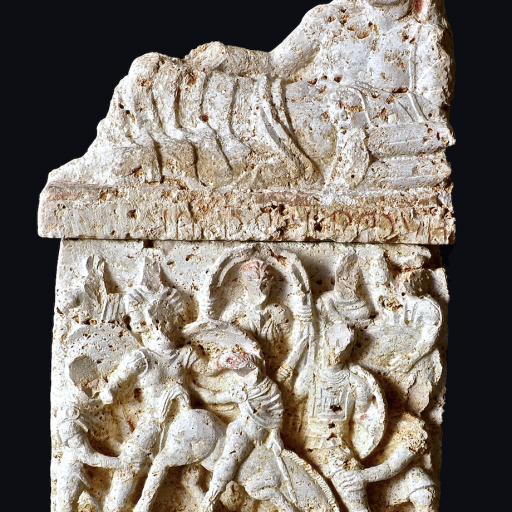
Tra i membri della gens è Au(le) Casni Ar(nthial) Caial (72) il cui coperchio è decorato con una figura maschile semidistesa, a torso nudo e con capo velato.
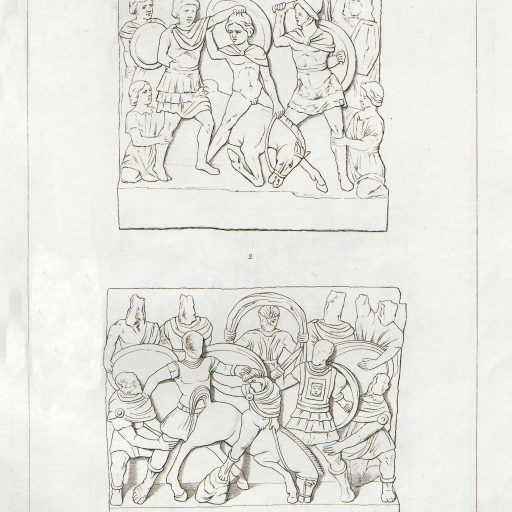
Sulla cassa è rappresentato l’agguato mortale di Achille a Troilo, il più giovane dei figli del re di Troia. La storia del giovane è legata ad una profezia: se avesse compiuto vent’anni la città di Troia non sarebbe caduta. Achille tende un agguato a Troilo fuori dalle mura della città dove il giovane si era recato per abbeverare i cavalli, accompagnato dalla sorella Polissena. Nel nostro rilievo, Achille al centro di una scena composta da dieci personaggi, afferra Troilo per i capelli. Alle spalle dei due Polissena con il manto che si incurva rigonfio sopra la testa.
Il mito, piuttosto diffuso sulle urne ellenistiche, può alludere al compimento di una drammatica profezia, all’impossibilità di difendersi e a una morte prematura.
Gli epitaffi delle urne lasciano intuire un quadro complesso di relazioni familiari evidenziato da sepolture bisome, possibili adozioni e insoliti e curiosi legami tra donne o cognate.
Fa(sti) Casnia Au(leś) Vipial e Trisnei Tucuntineś ad esempio erano riunite, per motivi non facilmente intuibili, all’interno della stessa urna cineraria (dispersa).
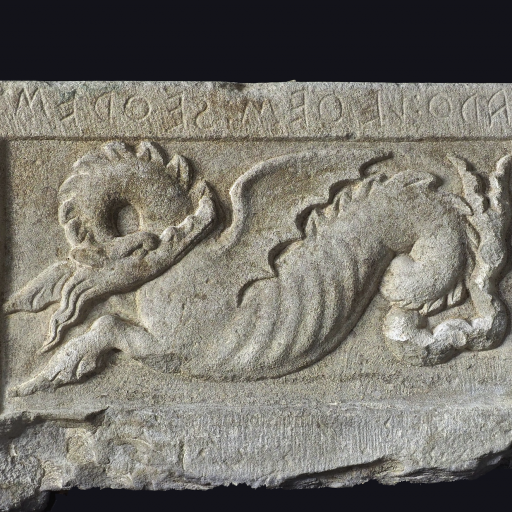
Fasti Cai Letheś (urna incorporata nel basamento di una casa nei pressi della necropoli), sorella della madre di Aule Casni (72), trovò posto all’interno della tomba dei Casni insieme a suo marito Larth Letheś Sethreś (56, con mostro marino sulla cassa) determinando l’ingresso dei Lethe in questo sepolcro.
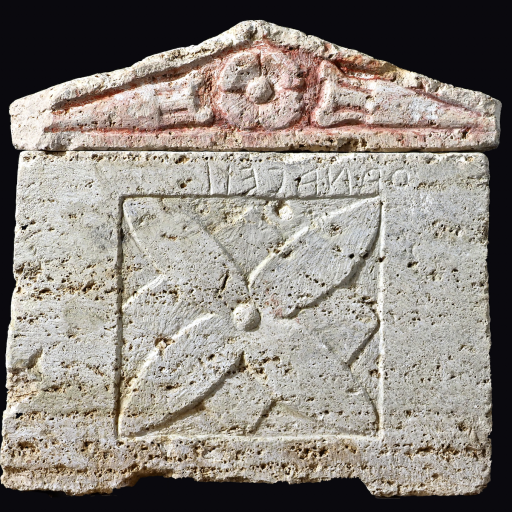
Anche Aule Petruś Casniś puiac Lethi (urna dispersa) sposa una Lethi ed è sepolto con lei (puia significa “moglie”). In questo caso Aule, porta un doppio gentilizio Petru e Casni e potrebbe essere stato perciò adottato (sulla questione anche la famiglia Cacni). L’urna 44 in origine presentava una doppia iscrizione, dipinta in nero, sul coperchio Arnth Casni Au(les) ed incisa sulla cassa, Thana Veti, verosimilmente ad indicare la riunione di un uomo e di una donna nello stesso cinerario.
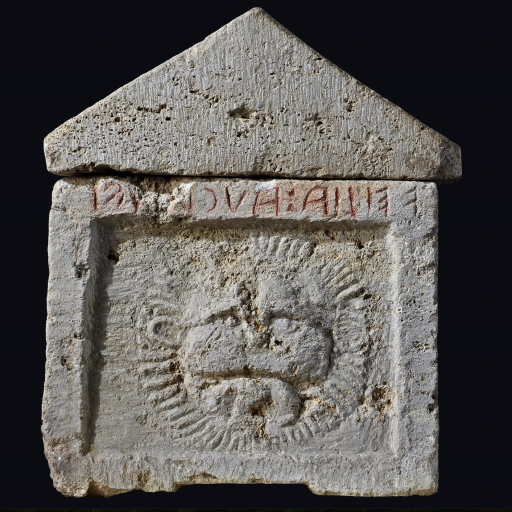
La seconda tomba conteneva le urne di 5 uomini della famiglia Casni e di 3 donne, due delle quali sposate con membri della famiglia. L’unica che si è conservata è quella di Veilia Auclinei (66) con sulla cassa una testa di leone forse con anello bronzeo in bocca (oggi perduto) che potrebbe imitare la borchia zoomorfa di una maniglia in metallo. All’interno conserva ancora i resti ossei combusti della defunta. In occasione del riallestimento 2026, la cassa è stata associata a un coperchio “neutro”, così come nel caso del n. 56, in mancanza di quello originario.
IMMAGINI:
- Urna 44.
- Urna 56.
- Urna 66.
- Urna 72.
- Uccisione di Troilo, tavola XXIV/L tratta da C. Conestabile, G.B. Vermiglioli, Dei Monumenti di Perugia etrusca e romana, Perugia, 1855-1870.
Casni
Unusual Family Ties ‘in the Shadow of the Velimna’
The family is documented in two separate tombs within the Palazzone necropolis, which together yielded twenty-five urns, most of which are now lost.
The architectural decoration of the first tomb closely recalls that of the monumental Hypogeum of the Velimna/Volumni family. Two dolphins were carved on the entrance wall, while the pediment above the opposite wall was decorated with a Gorgon’s head flanked by birds. A small owl was carved on one side of the chamber.
Among the members of the gens is Au(le) Casni Ar(nthial) Caial (72). The lid of his urn is decorated with a semi-reclining male figure shown bare-chested and with his head veiled.
The chest depicts Achilles’ fatal ambush of Troilus, the youngest son of the King of Troy. According to prophecy, Troy would never fall if Troilus reached the age of twenty. Achilles therefore lay in wait for the young prince outside the city walls, where he had gone to water his horses, accompanied by his sister Polyxena. In the relief, which includes ten figures, Achilles occupies the centre of the composition, seizing Troilus by the hair, while behind them Polyxena is shown with her billowing cloak arching above her head.
A frequent subject on Hellenistic urns, this myth may allude to the fulfilment of a tragic prophecy, the impossibility of escaping one’s fate, and an untimely death.
The epitaphs reveal a complex network of family relationships, reflected in the presence of double urns, possible adoptions, and unusual or intriguing connections between women or sisters-in-law.
For example, Fa(sti) Casnia Au(leś) Vipial and Trisnei Tucuntineś were buried together in the same cinerary urn (now lost), for reasons that remain difficult to explain.
Fasti Cai Letheś (whose urn was later incorporated into the foundations of a house near the necropolis), the sister of the mother of Aule Casni (72), was buried in the Casni tomb together with her husband, Larth Letheś Sethreś (56), whose urn chest is decorated with a sea monster. Their burial brought the Lethe family into the tomb.
Likewise, Aule Petruś Casniś puiac Lethi (urn lost) married a woman of the Lethe family and was buried with her (puia means ‘wife’). In this case, Aule bears the double gentilicium Petru and Casni, suggesting that he may have been adopted (see also the Cacni family). Urn 44 originally bore a double inscription: Arnth Casni Au(les), painted in black on the lid, and Thana Veti, carved on the chest, probably indicating that the urn contained the cremated remains of both a man and a woman.
The second tomb contained the urns of five men belonging to the Casni family and three women, two of whom had married members of the family. The only surviving example is the urn of Veilia Auclinei (66), whose chest is decorated with a lion’s head, perhaps originally fitted with a bronze ring held in its jaws (now lost), imitating the zoomorphic mount of a metal handle. The urn still preserves the cremated remains of the deceased. During the 2026 redisplay, the chest was paired with a plain replacement lid, as was also the case for urn 56, since the original lids had not survived.
IMMAGES:
- Urn 44.
- Urn 56.
- Urn 66.
- Urn 72.
- Ambush of Troilus, drawing XXIV/L from C. Conestabile, G.B. Vermiglioli, Dei Monumenti di Perugia etrusca e romana, Perugia, 1855-1870.
Galleria fotografica (scorri)
25 September 2026
1 urna 44
25 September 2026
2 urna 56
25 September 2026
3 urna 66
25 September 2026
4 urna 72
25 September 2026
5 Monumenti venuti alla luce per escavazioni eseguite in vari punt
Ultimo aggiornamento
29 Settembre 2026, 15:56