 Musei nazionali di Perugia – Direzione regionale Musei nazionali Umbria
 VETI AFLE
Veti Afle
Il piccolo Arnth, spose e madri
La tomba, scoperta nel 1843 nei pressi della Villa del Palazzone, appartiene ad un ramo della famiglia Veti, già attestata in altre sepolture della necropoli, ma se ne distingue per il cognome Afle, probabilmente acquisito per via parentelare (famiglia Afle, 37, 50, 61, 62). Il sepolcro conteneva 15 urne di uomini e donne, per lo più di modesta fattura. In esposizione ne sono presenti 5.
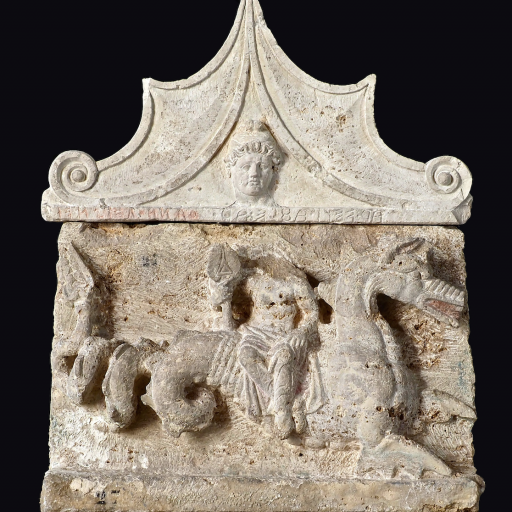
Solo per alcuni individui è stato possibile indicare i legami di parentela. L’urna più pregevole è quella che accoglie le ceneri di due sposi Ar(nth) Veti Afle Ar(nthial) e Thana Petsnei. (32).
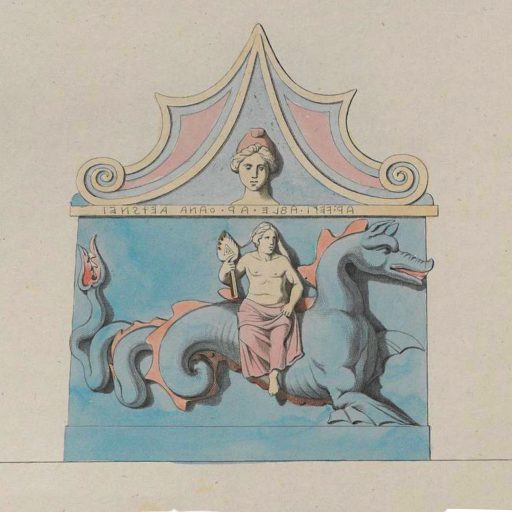
Sul coperchio è scolpito ad alto rilievo un volto con berretto “frigio” a punta ricurva, tipico dell’Asia minore (odierna Turchia) incorniciato lateralmente da due scudi semilunati (pelte) che in ambito funerario svolgono sia una funzione ornamentale che apotropaica (protettiva). Sulla cassa è raffigurata una donna munita di flabello (ventaglio) che cavalca un mostro marino. La testa, oggi mancante, doveva essere in origine velata come documentato da un disegno della seconda metà dell’Ottocento. Potrebbe trattarsi di una ninfa marina che simboleggia il viaggio del defunto attraverso il mare verso l’Aldilà.
Il restauro 2026 ha rivelato tracce dei colori originari, già segnalati al momento del rinvenimento: il rosa delle vesti della figura, il lilla che ne sottolinea i contorni e il rosso intenso della bocca e delle orecchie del mostro marino. I resoconti ottocenteschi aggiungono la presenza di un fondo azzurro e di oro per il ventaglio e la coda della creatura marina.
All’interno della cassa, tra le ceneri, un paio di orecchini d’oro ed un piccolo specchio rotondo.
Sparse al suolo e dentro un’urna, monete romane.
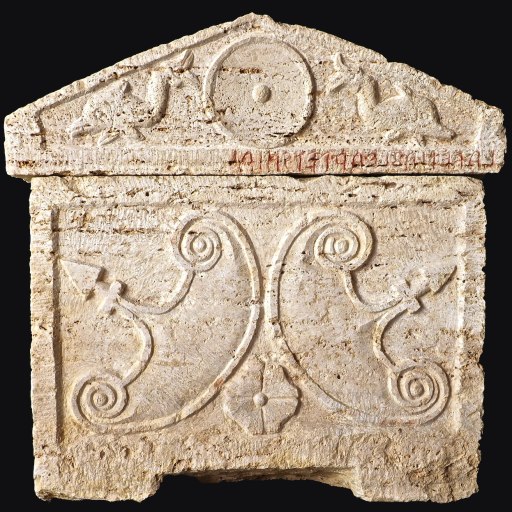
La tomba accoglieva anche le deposizioni dei due figli della coppia Ar(nth) V(e)t(i) Afle Petsnal e La(rth) Veti Afle Ar(nthial) Petsnial (45). Sul coperchio dell’urna di quest’ultimo (45) è scolpita una patera (piatto fondo) tra due delfini a significare sia il rito della libagione (patera) che la metafora del viaggio marino verso il mondo ultraterreno.
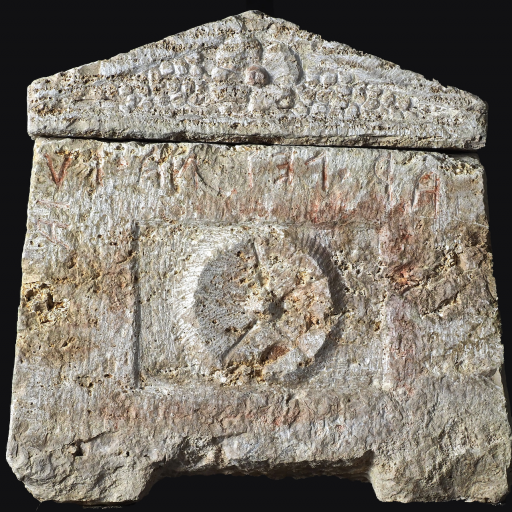
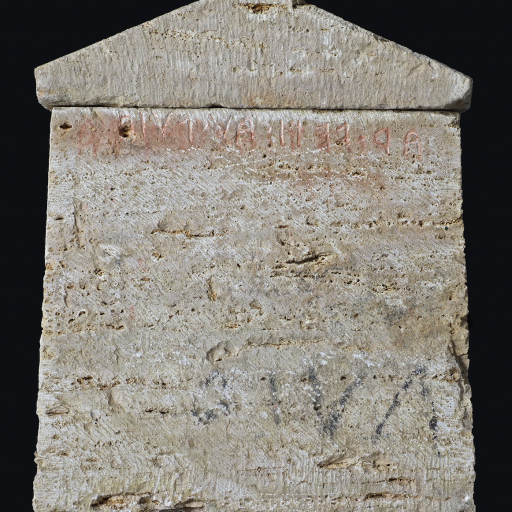
Nella tomba dovevano esserci altre coppie di sposi. Sulle urne di Ar(nth) Petsna puia (15) e Ar(nth) Veti Au(leś) puia (16) il termine puia sta a significare infatti moglie, anche se manca il nome proprio delle donne. In particolare sull’urna 16 puia ritorna per ben quattro volte: inciso accanto al nome del marito e ripassato in rosso, solo in parte sovrapposto; dipinto sotto l’iscrizione stessa; infine sulla cassa in basso a destra, enorme e in nero. Forse Ar(nth) Veti morì prima della moglie e la donna volle assicurarsi, più e più volte, di riposare al suo fianco per l’eternità: purtroppo nell’Ottocento le ossa non furono conservate e il dato, molto plausibile, non può essere confermato dai resti combusti.
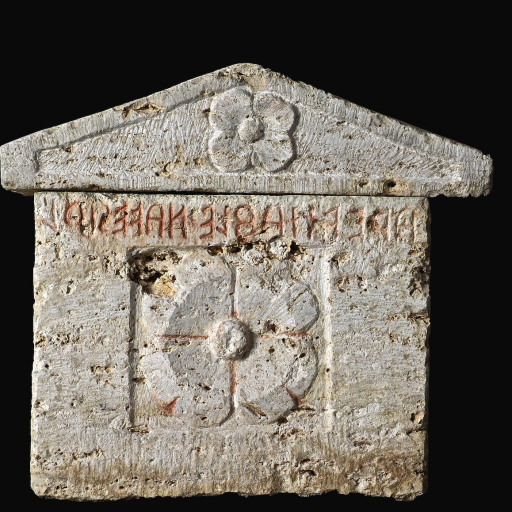
Tra i legami familiari che possono essere identificati con certezza c’è anche quello di Larthi Navesi Veties (non esposta), madre di 4 figli: tra loro l’urna di Ar(nth) Veti Afle Navesial (33) che presenta un fiore al centro della cassa ed un Arza Veti Naverial (urna non esposta) presumibilmente morto in giovane età dato il diminutivo utilizzato. In Etruria infatti il suffisso -za, aggiunto ai nomi propri (Arnth + za = Arza) indicava il concetto di piccolo o era utilizzato come vezzeggiativo per esprimere affetto, simpatia o tenerezza (all’Antiquarium il caso di Larza Cai Carcu).
IMMAGINI:
- Urna 15.
- Urna 16.
- Urna 32.
- Urna 33.
- Urna 45.
- Urna 32, disegno tratto da C. Conestabile, G.B. Vermiglioli, Dei Monumenti di Perugia etrusca e romana, Perugia, 1855-1870.
Veti Afle
The Little Arnth, Brides and Mothers
Discovered in 1843 near the Villa del Palazzone, this tomb belonged to a branch of the Veti family, already attested in other burials within the necropolis. It is distinguished, however, by the surname Afle, probably acquired through marriage or kinship ties (see the Afle family urns 37, 50, 61 and 62). The burial contained fifteen urns belonging to both men and women, most of them of modest workmanship. Five are currently on display.
Only a few family relationships can be identified with certainty. The finest urn is that containing the ashes of the married couple Ar(nth) Veti Afle Ar(nthial) and Thana Petsnei (32).
The lid is carved in high relief with a face wearing a pointed, forward-curving Phrygian cap, a type associated with Asia Minor (modern-day Türkiye), flanked by two crescent-shaped shields (peltae), which in funerary contexts served both decorative and apotropaic (protective) purposes. The front of the chest is decorated with a female figure holding a flabellum (ceremonial fan) while riding a sea monster. The head, now lost, was originally veiled, as shown in a drawing dating from the second half of the nineteenth century. The figure may represent a sea nymph, symbolising the deceased’s voyage across the sea to the Afterlife.
Conservation treatments carried out in 2026 revealed traces of the original polychromy, already noted at the time of discovery: pink on the figure’s garments, lilac outlining her form, and vivid red on the mouth and ears of the sea monster. Nineteenth-century accounts also record a light blue background and gilding on the fan and the tail of the marine creature.
Inside the urn, among the cremated remains, were a pair of gold earrings and a small circular mirror. Roman coins were found scattered on the floor of the tomb and inside one of the urns.
The tomb also contained the burials of the couple’s two sons, Ar(nth) V(e)t(i) Afle Petsnal and La(rth) Veti Afle Ar(nthial) Petsnial (45). The lid of the latter’s urn (45) is decorated with a patera (libation bowl) flanked by two dolphins, alluding both to the ritual of libation and to the metaphor of the sea voyage to the world beyond.
The tomb probably housed the remains of other married couples as well. On the urns of Ar(nth) Petsna puia (15) and Ar(nth) Veti Au(leś) puia (16), the word puia means “wife”, although the women’s personal names are omitted. On urn 16, in particular, the word puia appears no fewer than four times: incised beside the husband’s name and partially overwritten in red; painted beneath the inscription; and finally painted in large black letters at the lower right of the chest. It is possible that Ar(nth) Veti died before his wife and that she wished, by repeating the word several times, to ensure that she would rest beside him for eternity. Unfortunately, the skeletal remains were not preserved during the nineteenth-century excavation, so this plausible interpretation cannot be confirmed by the surviving cremated remains.
Among the family relationships that can be identified with certainty is that of Larthi Navesi Veties (urn not displayed), the mother of four children. These include Ar(nth) Veti Afle Navesial (33), whose urn is decorated with a flower at the centre of the chest, and Arza Veti Naverial (urn not displayed), who probably died at a young age, as suggested by the diminutive form of his name. In Etruria, the suffix -za, when added to a personal name (for example Arnth → Arza), conveyed the meaning of ‘little’ and could also function as an affectionate diminutive expressing fondness or tenderness. Another example is Larza Cai Carcu, whose urn is displayed in the Antiquarium.
IMAGES
- Urn 15.
- Urn 16.
- Urn 32.
- Urn 33.
- Urn 45.
- Urn 32, drawing from G.C. Conestabile, G.B. Vermiglioli, Dei Monumenti di Perugia etrusca e romana, Perugia, 1855-1870.
Galleria fotografica (scorri)
25 September 2026
1 urna 15
25 September 2026
2 urna 16
25 September 2026
3 urna 32
25 September 2026
4 urna 33
25 September 2026
5 urna 45
25 September 2026
6 urna 32 disegno
Ultimo aggiornamento
29 Settembre 2026, 16:00