 Musei nazionali di Perugia – Direzione regionale Musei nazionali Umbria
 VIPI VERCNA
Vipi Vercna
Lamine plumbee, planimetrie e iscrizioni
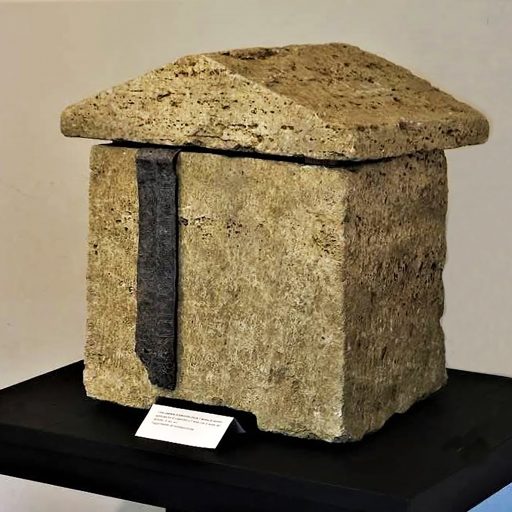
Questo grande ipogeo fu scoperto nel 1852 nei pressi della Villa del Palazzone. Le urne deposte erano 18, 10 di uomini e 8 di donne (6 delle quali erano mogli dei Vipi Vercna e 2 figlie). Le 7 urne conservate sono esposte sui gradoni dell’Ipogeo: l’iscrizione di Larthi Vipi moglie di Tite Satna, figlia di una Vatini/Vatinia incisa su una lamina di piombo è visibile all’Antiquarium.
Questa tomba, insieme a quella degli Acsi e dei Petru e Trile, è caratterizzata dall’uso di lamine plumbee, inserite tra cassa e coperchio che sostituiscono l’epitaffio, inciso o dipinto, dedicato al defunto: in due casi l’iscrizione è doppia, sull’urna e sul piombo. La pratica è documentata tra fine III e II sec. a.C., limitatamente a pochi casi. Tra le possibili interpretazioni che si sia trattato di una sorta di appunto di bottega: il committente recandosi dal lapicida avrebbe comunicato il nome del proprio defunto e l’artigiano potrebbe aver inizialmente preso nota sul piombo, materiale duttile e facile da incidere, senza poi trascrivere l’epitaffio, come di consueto, sull’urna stessa.
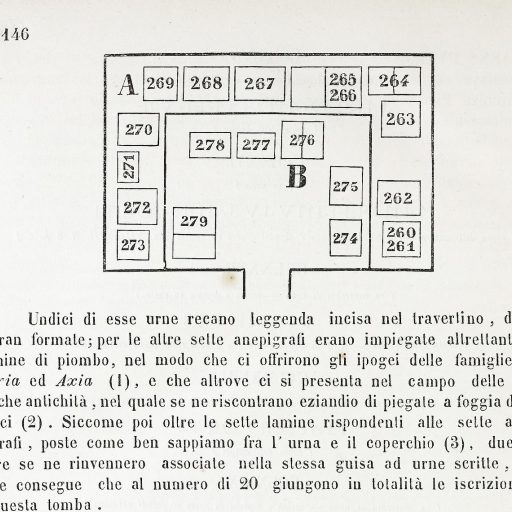
Al momento della scoperta fu rilevata la planimetria della camera funeraria, come raramente accade negli scavi ottocenteschi. La conoscenza della disposizione delle urne ci aiuta, almeno in parte, insieme alle iscrizioni, a tracciare una genealogia, anche se l’assenza, in molti epitaffi, del patronimico e del metronimico (i nomi dei genitori) non ci permette di individuare con certezza tutti i rapporti di parentela.
Tre fratelli, Larth (48), Aule e Arnth (36), figli di Sethre, sepolto altrove, e di Fasti Vatini, deposti sulla banchina di fondo, devono aver fondato il sepolcro. Accanto a loro le mogli e, sulla banchina sinistra anche la madre e la sorella.
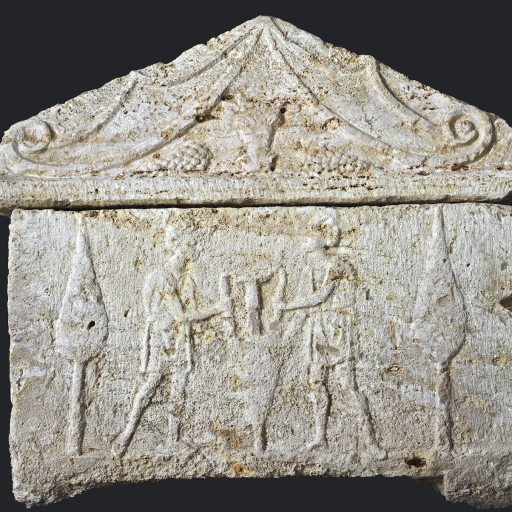
Sulla cassa di Larth (48) due individui sorreggono un’anfora: si tratta sicuramente, anche per la presenza di cipressi, di un’offerta funebre (sul tema anche l’urna 27 dei Cacni).
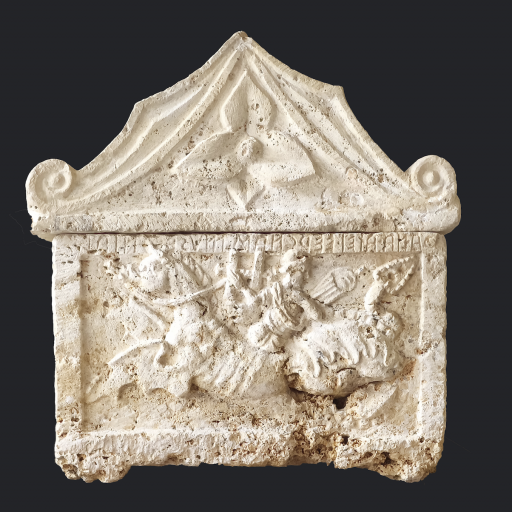
Arnth ha sposato Thana Atei (49) che ha un bel rilievo sulla cassa simboleggiante il viaggio (per mare) verso l’Aldilà: una suonatrice di arpa a cavallo di un ippocampo.
Ha almeno due figli, maschio e femmina, Larth e Larthi.
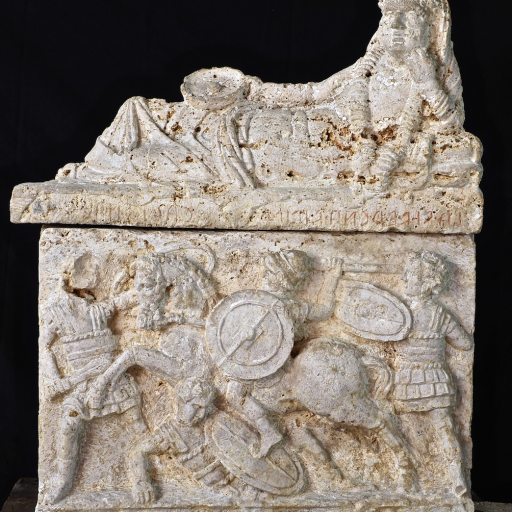
Le urne in genere sono piuttosto semplici, solo in un caso con il defunto sul coperchio (59).
In pianta furono segnalati anche il rinvenimento di ceramica e di specchi.
Immagini:
- L’urna con lamina plumbea esposta all’Antiquarium (foto vecchio allestimento).
- Planimetria della tomba tratta da C. Conestabile, G.B. Vermiglioli, Dei Monumenti di Perugia etrusca e romana, Perugia, 1855-1870.
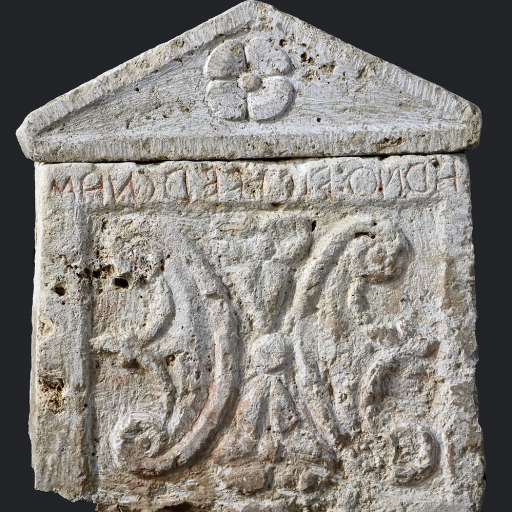
- Urna 36.
- Urna 48.
- Urna 49.
- Urna 59.
Vipi Vercna
Lead Plates, Plans and Inscriptions
This large hypogeum was discovered in 1852 near the Villa del Palazzone. It originally contained eighteen urns: ten belonging to men and eight to women, six of whom were wives of the Vipi Vercna family and two their daughters. The seven surviving urns are displayed on the stepped tiers within the Hypogeum modern building, while the lead plate bearing the inscription of Larthi Vipi, wife of Tite Satna and daughter of a member of the Vatini/Vatinia family, is exhibited in the Antiquarium.
Together with the tombs of the Acsi and the Petru and Trile families, this hypogeum is distinguished by the use of inscribed lead plates placed between the urn chest and the lid in place of the usual painted or carved epitaph. In two instances, the inscription appears both on the urn and on the lead plate. This practice is documented only in a small number of cases between the late third and second centuries BC. One possible explanation is that the lead plate served as a workshop memorandum: when commissioning the urn, the family may have given the name of the deceased to the stonecutter, who first noted it on the easily incised lead before, in some cases, failing to transfer the inscription onto the urn itself.
At the time of discovery, the ground plan of the burial chamber was recorded, a rare occurrence in nineteenth-century excavations. Together with the inscriptions, the original arrangement of the urns allows at least a partial reconstruction of the family’s genealogy. However, because many epitaphs omit the patronymic and metronymic (the names of the father and mother), it is impossible to identify every family relationship with certainty.
Three brothers – Larth (48), Aule, and Arnth (36) – the sons of Sethre, who was buried elsewhere, and of Fasti Vatini, appear to have founded the tomb. Their urns occupied the rear bench of the burial chamber, flanked by those of their wives, while the left-hand bench also accommodated their mother and sister.
The chest of Larth‘s urn (48) is decorated with two figures carrying an amphora. The presence of cypress trees makes it clear that the scene represents a funerary offering (the same subject also appears on urn 27 of the Cacni family).
Arnth married Thana Atei (49), whose urn bears a finely carved relief symbolising the journey to the Afterlife by sea: a harp player riding a hippocamp. They had at least a son, Larth, and a daughter, Larthi.
The urns are generally plain, and only one example (59) depicts the deceased reclining on the lid. The excavation plan also records the discovery of pottery and bronze mirrors among the grave goods.
Images:
- Urn with lead plate, on dispaly at the Antiquarium (photo of former dispalay).
- Plan of the tomb, from C. Conestabile, G.B. Vermiglioli, Dei Monumenti di Perugia etrusca e romana, Perugia, 1855-1870.
- Urn 36.
- Urn 48.
- Urn 49.
- Urn 59.
Galleria fotografica (scorri)
25 September 2026
1 urna con lamina plumbea
25 September 2026
2 planimetria della tomba
25 September 2026
3 urna 36
25 September 2026
4 urna 48
25 September 2026
5 urna 49
25 September 2026
6 urna 59
Ultimo aggiornamento
29 Settembre 2026, 16:01