 Musei nazionali di Perugia – Direzione regionale Musei nazionali Umbria
Il corredo della tomba degli Acsi/The grave goods of the tomb Acsi
Il corredo della tomba degli Acsi
Cimeli di famiglia e simboli di rango
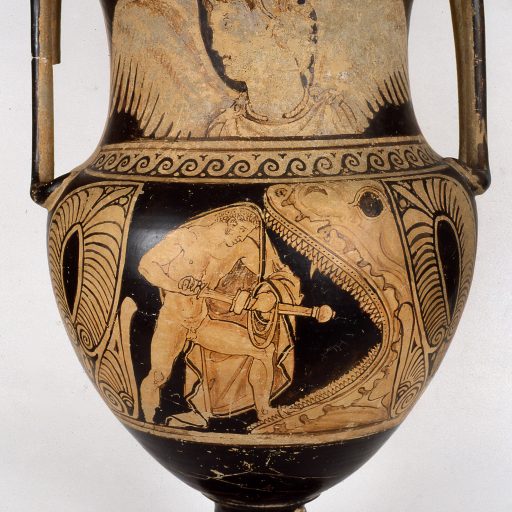
L’ipogeo degli Acsi fu scoperto nel 1843, vicino a quello dei Volumni. È una tomba prevalentemente maschile, contenente pregevoli reperti (come ad eempio gli schinieri in bronzo esposti al Museo archeologico nazionale dell’Umbria), da interpretarsi forse anche come bottino di guerra a seguito della partecipazione della famiglia a eventi bellici di grande portata.Tra i materiali spiccano due crateri, grandi vasi, destinati nella vita quotidiana a contenere vino, in ambito funerario all’uso saltuario come cinerari. Sono attribuibili ad epoca antecedente (IV sec. a.C.) all’utilizzo del sepolcro (II sec. a.C.) e devono considerarsi probabilmente veri e propri cimeli di famiglia.Si distinguono, oltre che per le dimensioni, in un caso, per la decorazione plastica nella porzione superiore del vaso, di probabile produzione o ispirazione magno-greca, nell’altro per l’originale raffigurazione del mito di Eracle ed Esione, rappresentato sul cratere a colonnette (kelebe) di produzione volterrana (seconda metà del IV sec. a.C.) attribuito ad un artista che da questa opera prende il nome di Pittore di Esione/Hesione. L’episodio dell’uccisione del mostro è raffigurato, con notevoli capacità tecniche ed artistiche, su un lato del cratere mentre sull’altro è l’epilogo dell’impresa eroica con Eracle ed Esione, ormai salvi e felicemente abbracciati. La famiglia degli Acsi vanta così le stesse doti di coraggio, forza e destrezza dall’eroe greco, figlio di Zeus, nel risultare vittoriosa in imprese quasi impossibili. Sul lato principale del cratere, Eracle, proteggendosi con il mantello dai miasmi velenosi, si appresta a sguainare la spada e a inoltrarsi nelle fauci spalancate della terribile creatura, di cui è raffigurata solo l’enorme testa, con l’occhio dilatato, i denti acuminati, le squame. Balzano agli occhi la grandiosità dell’impianto compositivo e l’uso del chiaroscuro, ottenuto con sapienti pennellate di vernice diluita che conferiscono eccezionali effetti di profondità illusionistica e che ricollegano l’artista al mondo della pittura più che a quello della ceramografia, facendo della kelebe del Palazzone uno dei migliori esempi della produzione volterrana di IV sec. a.C.
Immagini:
Tomba degli Acsi, necropoli del Palazzone (II-I sec. a.C.).
- Cratere plastico.
2-3. Kelebe (cratere a colonnette), lati A e B.
The grave goods of the tomb Acsi
Family heirlooms and symbols of rank
The hypogeum of the Acsi family was discovered in 1843 close to the tomb of the Volumni family. It is a predominantly male tomb, containing valuable objects – including the bronze greaves now on display at the National archaeological Museum of Umbria – that may also be interpreted as war booty, following the family’s involvement in major military campaigns.Two large kraters stand out among the finds. In daily life, these vessels were used for mixing and containing wine; in funerary contexts, they were occasionally reused as cinerary urns. Dating to an earlier period (4th century BC) than the use of the tomb itself (2nd century BC), they were probably genuine family heirlooms. In addition to their imposing size, the two kraters stand out for their distinctive decoration. One has moulded relief decoration on the upper part of the vessel, probably of Magna Graecian origin or inspiration. The other, a column-krater (kelebe) made in Volterra during the second half of the 4th century BC, features an unusual depiction of the myth of Heracles and Hesione. It is attributed to the Hesione Painter, an artist named after this work. On one side of the krater the episode of the monster’s slaying is depicted with remarkable technical and artistic skill, while the other shows the happy ending of the heroic deed: Heracles and Hesione, now safe, embrace each other. The Acsi family were therefore claiming for themselves the same courage, strength and skill as the Greek hero, son of Zeus, who triumphed in seemingly impossible exploits. On the main side of the krater, Heracles shields himself from the poisonous fumes with his cloak as he prepares to draw his sword and enter the gaping jaws of the terrifying creature. Only its enormous head is shown, with its bulging eye, sharp teeth and scales. The striking composition and use of chiaroscuro, achieved through the use of skilful brushstrokes of diluted paint, creating remarkable effects of illusionistic depth, are particularly noteworthy. These features link the artist more closely to the world of painting than to ceramic decoration, making the Palazzone kelebe one of the finest examples of pottery to be produced at Volterra during the 4th century BC.
Images:
Tomb of the Acsi family, Palazzone necropolis (2nd-1st centuries BC).
- Plastic Krater.
2-3. Kelebe (column-krater), sides A and B.
Galleria fotografica (scorri)

22 October 2026
1. Cratere plastico.
22 October 2026
2-3. Kelebe (cratere a colonnette), lati A e B.

22 October 2026
2-3. Kelebe (cratere a colonnette), lati A e B.
Ultimo aggiornamento
23 Ottobre 2026, 09:47